HOME BLIND NOTE 01 OF 08
DIAGNOSIS
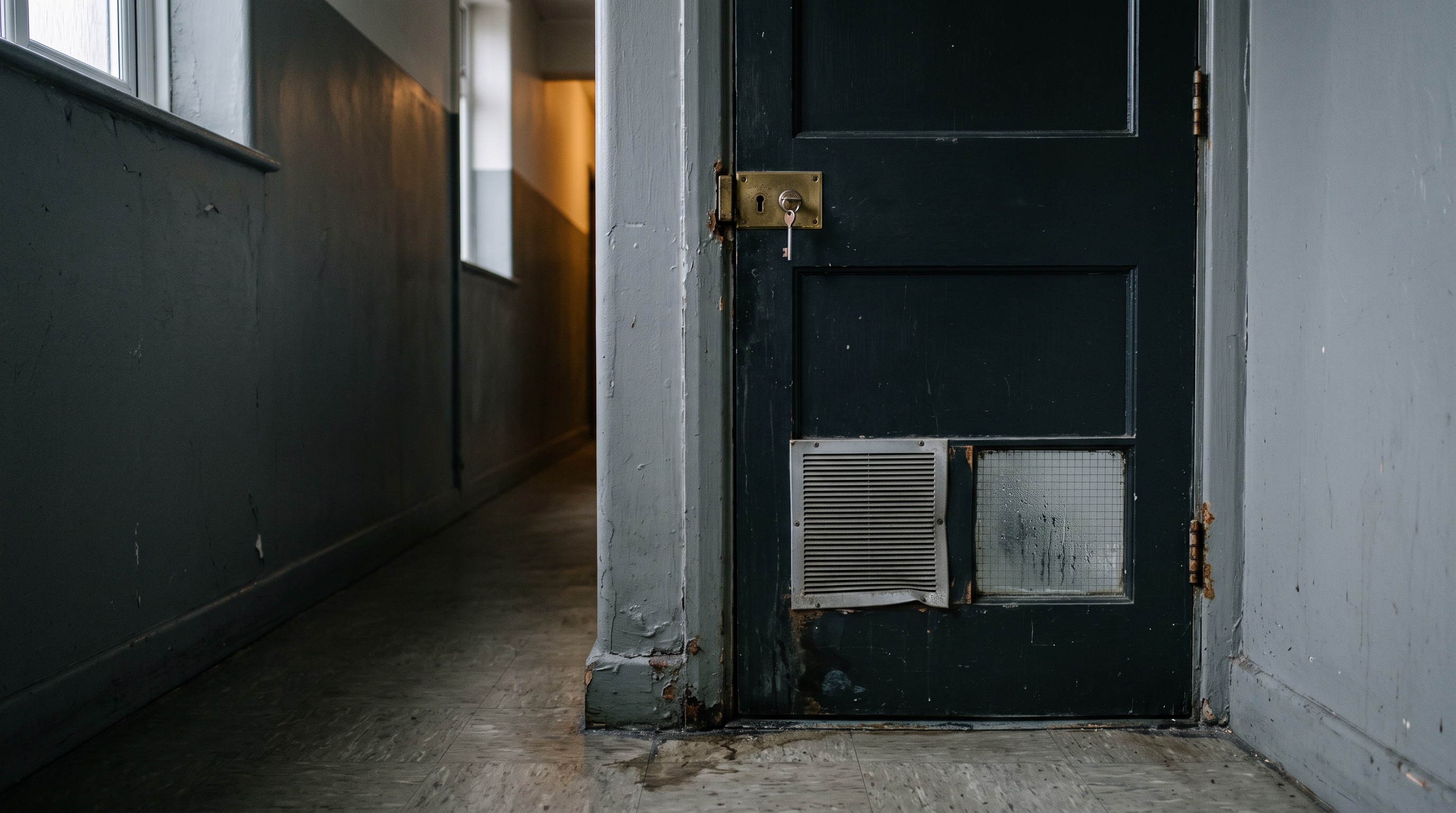
Walls Closing In
Visible danger is easy to name. Harder to recognise is the point at which an ordinary structure continues to operate while quietly transferring the work of protection onto the person inside it. Anxiety enters that gap not simply as distress, but as an early register of a promise being withdrawn before anything has visibly broken.
A lock can still turn and a door can still close long after a room has stopped feeling protective. That difference matters because refuge is not a property of walls alone. It is a condition in which vigilance can lower, attention can loosen, and the body is no longer required to treat its surroundings as a problem to solve. A structure can remain intact while that function quietly disappears.
The first signs are rarely dramatic. Damp gathers where it should not. Air moves, but never seems to refresh the room. A corridor remains passable while every turn feels like return. A key still fits a lock whose mechanism has become unreliable. None of these failures is large enough to announce a crisis on its own. Together, they create something harder to dismiss: an environment that continues to operate while becoming progressively less habitable.
When Function Leaves Form
This is where anxiety can acquire a different meaning. It does not have to be treated only as an emotion to be managed, or as a distortion laid over an otherwise neutral world. It can also function as a reading instrument. It registers the distance between what an environment still claims to be and what it now asks of the person inside it.
That distinction makes the ordinary more important than the spectacular. Nothing needs to collapse in public. A clock can continue counting. A ventilation system can still move air. A door can still shut. The language of operation remains available: open, running, working, occupied. But operation and protection are not the same thing. A place can satisfy the first description while failing the second.
Visible normality then becomes an alibi. When every surface is still present and every routine continues, alarm can appear excessive precisely because there is no single event large enough to justify it. The pressure is distributed across small mismatches: a room that cannot settle the body, a route that returns rather than leads out, noise that occupies the space where explanation should be, a mechanism that still accepts the key but no longer provides access in any meaningful sense.
No one of these has to carry the whole diagnosis. Their accumulation does.
The difficulty is not simply that something has failed. It is that the failure remains hidden inside functioning forms. The structure can still demand trust after losing the capacity to deserve it. It can require adaptation, patience, productivity and calm while steadily increasing the amount of vigilance needed to remain inside it. The person living there is then placed in an impossible position: respond to the warning and risk appearing irrational, or ignore it and become increasingly dependent on a system already withdrawing its protection.
An Alarm Without an Incident
An alarm without a visible incident is difficult to defend. Public language prefers thresholds: broken or working, safe or unsafe, crisis or normality. But lived conditions often deteriorate before they cross any official line. What disappears first may be less measurable: ease, trust, the ability to stop scanning, the expectation that a mechanism will behave tomorrow as it behaved yesterday.
In that interval, anxiety has information.
This does not mean every alarm is correct, or that fear should automatically be treated as evidence. The claim is narrower. When a structure preserves its appearance while changing its function, discomfort may register that change before the surrounding language has found a name for it. The body can notice a promise withdrawing before the system is prepared to admit that anything has changed.
That is why the question is not simply whether the walls are standing. The question is what the walls now require in exchange for staying inside them.
Refuge begins to disappear when protection must be constantly produced by the person who was meant to receive it: checking, compensating, adapting, absorbing, remaining alert. At that point, shelter has begun to resemble maintenance. Access has become friction. Routine has become containment.
The most important shift is therefore not from safety to catastrophe. It is from safety to a condition that still looks sufficiently normal to deny the need for alarm.
Once that warning is allowed to count as evidence, collapse no longer begins with the moment something breaks. It begins earlier, in the distance between a structure and the function it continues to promise.
ENTER THE TRACK
Watch the film / Read the lyrics